

Última atualização: 26 de julho de 2026
Resposta rápida: Para escolher o melhor fabricante ou fornecedor de ladrilhos táteis para cegos na Índia, verifique as certificações dos produtos, a qualidade dos materiais, a experiência em fabricação e a capacidade de atender a pedidos em grande volume dentro do prazo. Sempre solicite amostras e relatórios de testes antes de fazer um pedido grande. Tanto fornecedores sediados na Índia quanto aqueles que se abastecem junto a fabricantes consolidados na China podem ser boas opções, desde que os padrões de qualidade sejam cumpridos.
Principais conclusões
- Os ladrilhos táteis para pessoas cegas podem ser divididos em dois tipos principais: de aviso (padrão de pontos) e direcionais (padrão de barras). São necessários os dois para se ter um sistema completo.
- Os códigos de construção da Índia (NBC 2016 e Lei RPWD de 2016) tornam obrigatória a instalação de pavimentação tátil em muitos edifícios e espaços públicos.
- Um bom piso tátil deve ser antiderrapante, durável e estar em conformidade com as normas IS ou ISO. Sempre solicite os relatórios de teste.
- Na Índia, o preço varia aproximadamente entre 50 e mais de 300 rúpias indianas por ladrilho, dependendo do material, do tamanho e do fornecedor.
- Azulejos falsificados ou de baixa qualidade costumam apresentar padrões de pontos pouco profundos, tamanhos inconsistentes e não possuem certificações. Saiba como identificá-los.
- Os ladrilhos táteis de cerâmica e vitrificados são os mais populares para o clima da Índia, pois suportam bem o calor e a chuva.
- Sempre peça um pedido de amostra antes de se comprometer com uma compra em grande quantidade. Verifique os prazos de entrega, a garantia e o suporte pós-venda.
- A Morera Ceramics, com sede em Foshan, na China, é uma das fornecedoras que exporta azulejos táteis comerciais para a Índia e outros mercados.
O que são ladrilhos táteis e como eles ajudam as pessoas cegas?
Os ladrilhos táteis para pessoas cegas são ladrilhos de piso especialmente projetados, com padrões em relevo na superfície que podem ser percebidos ao pisar. Eles orientam as pessoas com deficiência visual em espaços públicos com segurança, sem a necessidade de usar a visão.
Existem dois padrões principais de superfície:
- Pontos em relevo (ladrilhos de aviso): Peça à pessoa para parar ou tomar cuidado. Utilizado em cruzamentos, escadas, bordas de plataformas e zonas de risco.
- Barras elevadas (ladrilhos direcionais/guia): Indique à pessoa em que direção deve seguir. Utilizado em trilhas, corredores e calçadas.
Juntas, essas placas criam um “caminho tátil” que uma pessoa pode seguir usando uma bengala branca ou sentindo a textura com os pés. Para entender melhor como esses sistemas funcionam, consulte este guia completo sobre vias táteis.
Além dos usuários cegos, os ladrilhos táteis também ajudam pessoas com baixa visão, idosos com problemas de equilíbrio e qualquer pessoa que não esteja familiarizada com um novo espaço.
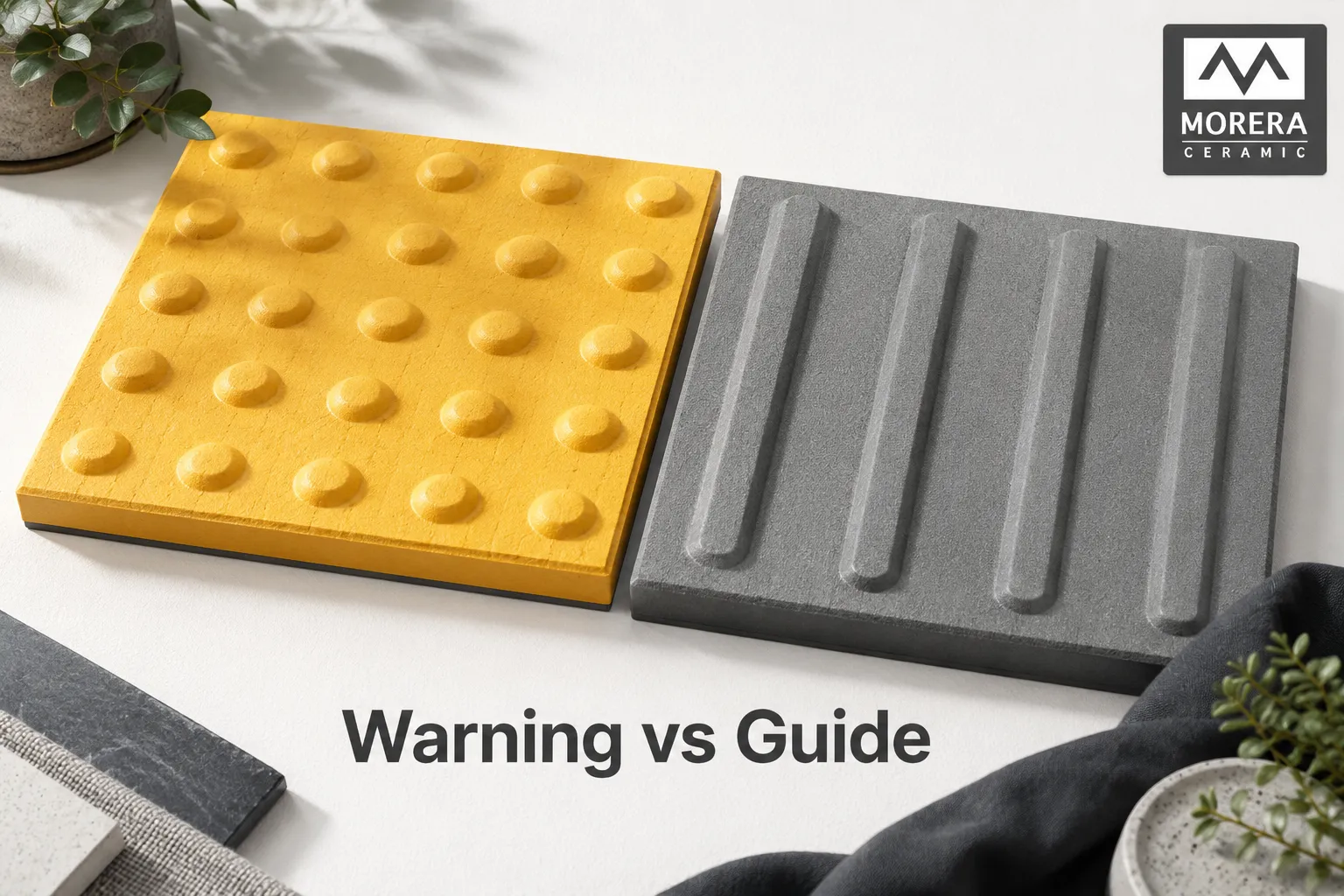
Diferença entre ladrilhos de alerta tátil e ladrilhos direcionais
As placas de aviso e as placas de sinalização não são a mesma coisa. Usar o tipo errado no lugar errado é um erro comum e que pode custar caro.
| Recurso | Ladrilhos de aviso | Ladrilhos direcionais |
|---|---|---|
| Padrão de superfície | Pontos em relevo (cúpulas truncadas) | Barras paralelas elevadas |
| Finalidade | Sinal de perigo ou ponto de parada | Orientação sobre a direção da caminhada |
| Locais comuns | Escadas, passagens, bordas das plataformas | Corredores, calçadas, praças abertas |
| Cor (padrão indiano) | Amarelo ou cor contrastante | Amarelo ou cor contrastante |
Regra de decisão: Se o local for uma zona de risco (escadas, beira da estrada, plataforma), use ladrilhos de aviso. Se o local for uma trilha para caminhada, use ladrilhos de sinalização. A maioria dos projetos precisa dos dois.
Você pode saber mais sobre esses dois tipos de produtos neste guia sobre os dois melhores tipos de produtos táteis para pedestres.
Os ladrilhos táteis são obrigatórios nos códigos de construção da Índia?
Sim, os ladrilhos táteis são exigidos por lei em muitos edifícios e espaços públicos da Índia. Duas leis principais regulamentam essa questão:
- Lei dos Direitos das Pessoas com Deficiência (RPWD), de 2016: Exige recursos de acessibilidade, incluindo percursos táteis em prédios públicos, centros de transporte e repartições públicas.
- Código Nacional de Construção (NBC) de 2016: Inclui diretrizes específicas para o projeto acessível, incluindo pisos táteis em áreas públicas.
Qualquer proprietário de pequena empresa que esteja construindo ou reformando um espaço comercial aberto ao público deve considerar o pavimento tátil como um requisito de conformidade, e não apenas um recurso opcional. O descumprimento pode resultar em multas ou na rejeição do projeto durante a inspeção.
No que diz respeito aos espaços públicos ao ar livre, as diretrizes são especialmente rigorosas nas proximidades de estações de metrô, terminais de ônibus, aeroportos e hospitais.
Os melhores fabricantes de ladrilhos táteis da Índia (e fornecedores confiáveis)
A Índia conta com vários fabricantes nacionais e também importa ladrilhos táteis de qualidade de países como a China. Veja a seguir o que deve ser levado em consideração ao avaliar qualquer fornecedor:
Fabricantes indianos nacionais são frequentemente encontrados em pólos de fabricação de azulejos como Morbi (Gujarat), que é um dos maiores centros de produção de azulejos cerâmicos da Ásia. Esses fornecedores podem oferecer entregas mais rápidas na Índia e uma comunicação mais fácil.
Importar fornecedores da China (como a Morera Ceramics, com sede em Foshan) costumam oferecer uma linha de produtos mais ampla, preços competitivos e qualidade consistente para pedidos em grande quantidade. Foshan é um importante centro global de fabricação comercial de azulejos.
Ao comparar qualquer fornecedor, verifique os seguintes pontos:
- Eles são especializados em ladrilhos táteis ou isso é apenas um produto secundário?
- Eles podem apresentar referências de projetos na Índia ou em mercados semelhantes?
- Eles possuem certificações (ISO, CE ou normas BIS da Índia)?
- Qual é a quantidade mínima de pedido (MOQ) deles?
Para acessar uma lista selecionada de fornecedores certificados de ladrilhos táteis, acesse este diretório de fornecedores de ladrilhos táteis.
Quanto custam os ladrilhos táteis na Índia?
Os preços dos azulejos táteis na Índia variam de acordo com o material, o tamanho e a quantidade do pedido. Aqui estão algumas estimativas aproximadas (observação: trata-se de estimativas gerais do mercado, e os preços reais dependem do fornecedor e do tamanho do pedido):
- Ladrilhos táteis básicos de cimento/concreto: 40 a 80 INR por azulejo
- Ladrilhos cerâmicos táteis: 80 a 180 INR por azulejo
- Ladrilhos táteis vitrificados/de porcelana: De 150 a mais de 300 rúpias indianas por azulejo
- Ladrilhos táteis de borracha ou poliuretano: 100 a 250 INR por azulejo
Para pedidos em grandes quantidades (500 ou mais azulejos), a maioria dos fornecedores oferece descontos de 10 a 25%. Sempre pergunte sobre descontos por faixas de quantidade.
O custo da instalação é cobrado à parte. Para obter detalhes sobre a composição dos custos, consulte esta visão geral em Compreendendo os custos do pavimento tátil.
Erro comum: Escolher a opção mais barata sem verificar a espessura e a profundidade dos pontos. Um azulejo muito fino ou com pontos pouco profundos se desgastará rapidamente e não atenderá aos padrões.
Requisitos e normas para a instalação de ladrilhos táteis
Azulejos de boa qualidade, se instalados de forma inadequada, não funcionarão corretamente. A qualidade da instalação é tão importante quanto a qualidade dos azulejos.
Principais requisitos de instalação de ladrilhos táteis para usuários cegos na Índia:
- Preparação da superfície: O piso de base deve estar nivelado e limpo. Superfícies irregulares podem causar rachaduras ou levantamento dos azulejos.
- Seleção do adesivo: Utilize a cola para azulejos adequada ao ambiente (interno x externo, úmido x seco).
- Largura da junta de argamassa: Mantenha as juntas estreitas e uniformes (geralmente de 2 a 3 mm) para que o padrão tátil não seja interrompido.
- Alinhamento: As setas indicadoras de direção devem ser alinhadas na direção real do trajeto. Barras desalinhadas confundem os usuários.
- Contraste de cores: Os ladrilhos devem apresentar contraste visual com o piso ao redor para pessoas com baixa visão. O amarelo é a cor padrão mais comum na Índia.
- Continuidade: O percurso tátil deve ser contínuo, sem lacunas nem interrupções. Um percurso interrompido é pior do que a ausência de percurso.
Para instalação ao ar livre, certifique-se de que os azulejos sejam adequados para uso externo e possam suportar ciclos de congelamento e descongelamento, chuvas intensas e exposição direta ao sol.
Ladrilhos táteis para uso interno x externo: qual é a melhor opção?
A escolha do ladrilho certo depende do local onde ele será instalado. Os ladrilhos táteis para uso interno e externo têm requisitos diferentes.
Ladrilhos táteis para ambientes internos:
- É possível utilizar opções de cerâmica ou vitrificadas com resistência moderada ao deslizamento
- Ênfase na estética e no contraste de cores
- Menor exposição às intempéries, portanto os requisitos de durabilidade são um pouco menores
- Locais comuns: hospitais, shoppings, aeroportos, saguões de escritórios
Ladrilhos táteis para áreas externas:
- Deve ser altamente antiderrapante, especialmente quando molhado
- Precisa resistir ao desbotamento causado pelos raios UV, à geada e ao tráfego intenso de pedestres
- As opções de porcelana vitrificada ou concreto são as preferidas
- Locais comuns: calçadas, pontos de ônibus, plataformas ferroviárias, travessias
Regra de decisão: Se o azulejo for ficar exposto à chuva ou à luz solar direta, opte sempre por um azulejo adequado para uso externo com classificação de resistência ao deslizamento R11 ou superior. Para uso interno, as classificações R9 ou R10 costumam ser aceitáveis.
Para obter mais orientações sobre opções de ladrilhos antiderrapantes que complementam os sistemas de pavimentação tátil, consulte este recurso em ladrilhos de cerâmica antiderrapantes.
Que tamanho e espessura de ladrilhos táteis você deve escolher?
Os tamanhos padrão das telhas táteis utilizadas na Índia e na maioria dos mercados asiáticos são:
- 300 mm x 300 mm (30 x 30 cm): Mais comum em vias para pedestres
- 400 mm x 400 mm (40 x 40 cm): Utilizado em corredores mais largos e praças abertas
- 600 mm x 600 mm (60 x 60 cm): Menos comum em ladrilhos táteis, mais comum em pavimentos em geral
Recomendações de espessura:
- Uso em ambientes internos: geralmente, uma espessura de 8 mm a 10 mm é suficiente
- Uso ao ar livre: de 12 mm a 20 mm para maior durabilidade em locais de tráfego intenso
Altura do ponto/barra: O relevo deve ter de 4 mm a 5 mm de altura. Se for inferior a 3 mm, os usuários podem não senti-lo claramente, especialmente através de solas grossas de sapato.
Sempre confirme as dimensões exatas com seu fornecedor antes de fazer o pedido. Pequenas variações no tamanho causam problemas de alinhamento durante a instalação.
Como identificar ladrilhos táteis falsificados ou de baixa qualidade
Os azulejos táteis de baixa qualidade são um verdadeiro problema no mercado indiano. Veja aqui como identificá-los antes de comprar.
Sinais de baixa qualidade:
- Altura superficial dos pontos: Pontos com menos de 3 mm de altura não serão sentidos claramente sob os pés
- Inconsistência no tamanho: Azulejos cujo comprimento ou largura varie em mais de 1 mm não se alinharão corretamente
- Lasca na superfície: Bordas ou pontos que se lascam facilmente durante o manuseio indicam uma composição cerâmica frágil
- Não há relatórios de teste: Um fabricante de renome deve fornecer relatórios de testes de absorção de água, resistência ao deslizamento e resistência à flexão
- Desbotamento da cor: Pigmentos de baixa qualidade desbotam rapidamente sob a luz do sol, reduzindo a visibilidade para usuários com baixa visão
- Sem certificações: A ausência de certificação ISO, CE ou BIS é um importante sinal de alerta
Um teste rápido que você mesmo pode fazer: Deixe cair um azulejo da altura da cintura sobre um piso duro. Um azulejo de cerâmica de boa qualidade não deve rachar nem lascar. Além disso, passe o polegar pelos pontos. Eles devem parecer firmes e uniformes, sem aspereza nem irregularidades.
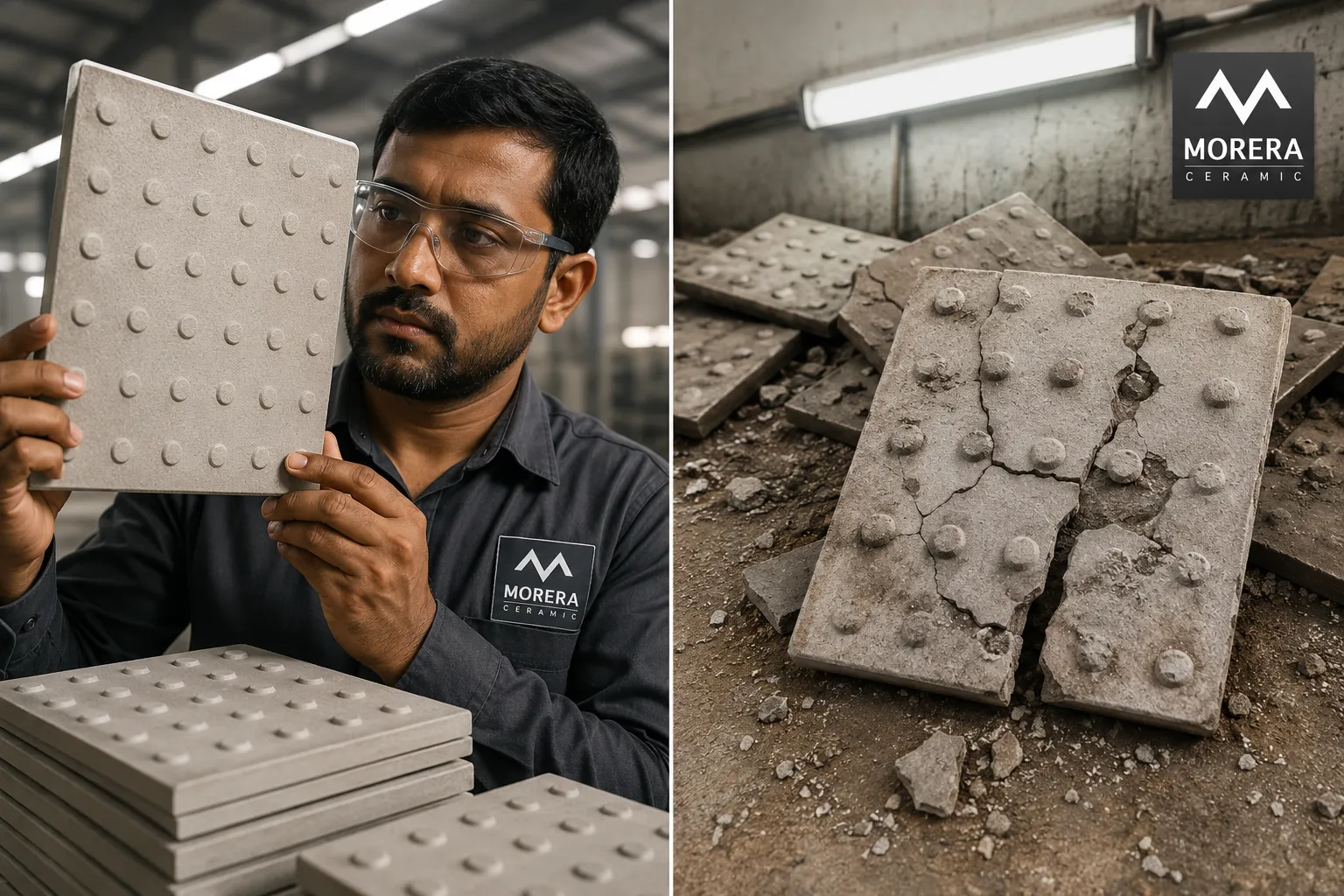
Para uma abordagem centrada no usuário na avaliação de produtos de azulejos, o Guia de ladrilhos táteis Morera abrange os principais indicadores de qualidade a serem verificados.
Quem mais precisa de ladrilhos táteis, além das pessoas cegas?
Os ladrilhos táteis para usuários cegos são a aplicação mais conhecida, mas esses ladrilhos atendem a um grupo mais amplo de pessoas.
- Pessoas com baixa visão: Ladrilhos táteis de alto contraste ajudam as pessoas a se orientarem, mesmo quando não conseguem ler as placas
- Pessoas idosas: Os padrões em relevo no piso fornecem um estímulo sensorial que ajuda na percepção espacial e no equilíbrio
- Pessoas com deficiência cognitiva: Percursos táteis consistentes reduzem a confusão em espaços amplos ou desconhecidos
- Turistas e visitantes: Em centros de transporte movimentados, os percursos táteis ajudam qualquer pessoa a encontrar o caminho até as saídas ou plataformas
- Crianças: Em escolas e espaços públicos, os percursos táteis proporcionam um nível adicional de segurança
Essa visão mais ampla, centrada no usuário, significa que investir em um bom pavimento tátil beneficia mais pessoas do que apenas os deficientes visuais. Isso é bom tanto para a reputação da empresa quanto para o cumprimento das normas.
Ladrilhos táteis x outras soluções de acessibilidade: uma comparação
Os ladrilhos táteis não são a única ferramenta de acessibilidade disponível, mas costumam ser a mais prática para instalações permanentes.
| Solução | Custo | Durabilidade | Manutenção | Melhor para |
|---|---|---|---|---|
| Ladrilhos cerâmicos táteis | Médio | Alta (15 a 20 anos) | Baixo | Espaços públicos permanentes |
| Tiras táteis de borracha | Baixa-Média | Médio (5 a 8 anos) | Médio | Uso temporário ou adaptação |
| Linhas táteis pintadas | Muito baixo | Baixo (1 a 2 anos) | Alta | A curto prazo ou apenas em ambientes fechados |
| Inserções táteis com saliências | Médio | Alta | Baixo | Reforma de pisos existentes |
| Sistemas de orientação por áudio | Alta | Alta | Alta | Grandes centros de transporte |
Para a maioria dos proprietários de pequenas empresas que estão realizando uma instalação permanente, os ladrilhos táteis de cerâmica ou vitrificados oferecem o melhor custo-benefício a longo prazo. Eles duram mais e exigem menos manutenção do que as alternativas de borracha ou pintadas.
Para saber mais sobre as opções de saliências táteis compatíveis com sistemas de azulejos, consulte este recurso em botões táteis para usuários cegos.
Erros comuns na escolha de ladrilhos táteis
Esses são os erros que os compradores cometem com mais frequência. Evitá-los economiza dinheiro e evita problemas de conformidade.
- Comprar levando em conta apenas o preço: O azulejo mais barato raramente é a melhor opção em termos de custo-benefício. Leve em consideração a durabilidade, o custo de instalação e a frequência de substituição.
- Não verificar a conformidade com as normas: Sempre verifique se o azulejo está em conformidade com a norma NBC 2016 ou com as normas IS pertinentes antes de fazer o pedido.
- Encomendar o tipo errado: Utilizar placas de sinalização direcional onde são necessárias placas de aviso (ou vice-versa) é um grave erro de segurança.
- Ignorando o pedido de amostra: Nunca faça um pedido em grande quantidade sem antes testar um lote de amostra.
- Ignorando o contraste de cores: Um ladrilho tátil da mesma cor do piso ao redor perde sua utilidade para usuários com baixa visão.
- Não perguntar sobre o prazo de entrega: Alguns fornecedores têm prazos de entrega de 4 a 8 semanas. Planeje com antecedência para evitar atrasos no projeto.
- Escolher um fornecedor que não ofereça suporte pós-venda: Se os azulejos chegarem danificados ou não estiverem de acordo com as especificações, você precisará de um fornecedor que responda e resolva o problema.
Dicas de durabilidade e manutenção de ladrilhos táteis
Bons pisos cerâmicos ou vitrificados com textura podem durar de 15 a 20 anos com os cuidados adequados. Veja a seguir como mantê-los em boas condições.
Dicas de manutenção:
- Limpe regularmente com um produto de limpeza de pH neutro. Evite ácidos ou álcalis agressivos, que podem danificar o esmalte.
- Inspecione as juntas de rejunte uma vez por ano. Refaça o rejunte em qualquer trecho rachado ou com faltas o mais rápido possível.
- Verifique periodicamente a altura dos pontos em áreas de alto tráfego. Pontos desgastados podem exigir a substituição dos ladrilhos.
- No caso de ladrilhos para áreas externas, remova rapidamente o musgo ou as algas que se formarem. Eles tornam a superfície escorregadia e podem danificá-la com o tempo.
- Guarde ladrilhos de reposição do mesmo lote. A cor e o tamanho podem variar entre as diferentes séries de produção; portanto, guardar ladrilhos de reposição do pedido original facilita reparos futuros.
Caso extremo: Nas regiões costeiras da Índia (como Mumbai ou Chennai), o ar salgado pode acelerar a deterioração da argamassa. Utilize argamassa de grau marítimo nesses locais.
Como encomendar ladrilhos táteis de fornecedores na Índia
Quer você esteja comprando de um fornecedor indiano ou importando de um fabricante como a Morera Ceramics, na China, o processo de encomenda segue etapas semelhantes.
Processo de compra passo a passo:
- Defina seus requisitos: Calcule a área a ser coberta. Meça com cuidado e acrescente 10% para compensar cortes e quebras.
- Escolha o tipo de azulejo: Ladrilhos de sinalização, ladrilhos direcionais ou ambos. Confirme o tamanho e a espessura.
- Solicitar amostras: Peça de 2 a 3 amostras de azulejos antes de fazer um pedido em grande quantidade.
- Solicite relatórios de testes: Solicite os resultados dos testes de resistência ao deslizamento, absorção de água e resistência à flexão.
- Solicite um orçamento por escrito: Inclua o preço unitário, a quantidade mínima de pedido (MOQ), o prazo de entrega e as condições de remessa.
- Confirmar certificações: Verifique se os azulejos estão em conformidade com a norma NBC 2016, as normas IS ou normas equivalentes.
- Negociar as condições: Pergunte sobre descontos por quantidade, condições de pagamento e garantia.
- Faça um pedido de teste: Comece com um pedido menor, se possível, e aumente a quantidade assim que a qualidade for confirmada.
- Verifique na entrega: Verifique se há lascas, inconsistências no tamanho e se as cores correspondem antes de aceitar a remessa.
Para uma experiência de compra centrada no usuário, o Pavimentação tátil para cegos A página do produto oferece uma boa visão geral de como é uma linha completa de produtos.
Perguntas a fazer a um fornecedor antes de fazer um pedido
Antes de assinar qualquer contrato de compra, faça estas perguntas diretamente:
- Seus azulejos estão em conformidade com as normas NBC 2016 ou IS? Um bom fornecedor responderá a essa pergunta com segurança e apresentará a documentação necessária.
- Qual é o prazo de entrega para pedidos em grandes quantidades? Os prazos de entrega habituais variam de 2 a 8 semanas, dependendo da quantidade e da localização.
- Vocês oferecem garantia? Solicite uma garantia de pelo menos 1 ano contra defeitos de fabricação.
- Vocês podem fornecer referências de projetos na Índia? Os projetos anteriores demonstram o desempenho na prática.
- Qual é o seu procedimento caso os azulejos cheguem danificados? Informe-se com antecedência sobre a política de troca ou reembolso.
- Vocês oferecem suporte técnico para a instalação? Alguns fornecedores oferecem orientações de instalação ou até mesmo suporte no local.
Sinais de alerta a serem evitados ao escolher um fornecedor
Alguns fornecedores parecem bons no papel, mas causam problemas depois que o pedido é feito. Fique atento a estes sinais de alerta:
- Não há endereço físico nem fotos da fábrica: Os fabricantes legítimos são transparentes quanto aos locais onde atuam.
- Preços que parecem baixos demais: Azulejos extremamente baratos quase sempre economizam nas matérias-primas ou na qualidade da queima.
- Especificações vagas do produto: Se um fornecedor não puder informar a altura exata dos pontos, a espessura dos ladrilhos e o índice de resistência ao deslizamento, isso é um problema.
- Sem política de amostras: Qualquer fornecedor sério enviará amostras. A recusa em fazê-lo é um sinal de alerta.
- Comunicação lenta ou pouco clara: Se eles demoram dias para responder a perguntas básicas antes da venda, espere um atendimento ainda pior depois.
- A Índia não possui experiência em exportação: Fornecedores que nunca fizeram remessas para a Índia podem não compreender os requisitos alfandegários, as normas de embalagem ou as exigências locais de conformidade.
PERGUNTAS FREQUENTES
P: Qual é a cor padrão dos ladrilhos táteis na Índia? O amarelo é a cor mais utilizada em ladrilhos táteis na Índia, pois proporciona um forte contraste visual com a maioria das superfícies de piso. Alguns projetos utilizam o vermelho ou o cinza, mas o amarelo é o padrão nacional para a maioria dos espaços públicos.
P: Posso usar ladrilhos táteis para áreas externas em ambientes internos? Sim, os ladrilhos táteis projetados para uso externo podem ser utilizados em ambientes internos. Eles costumam ser mais duráveis. No entanto, podem apresentar uma textura mais áspera, o que os torna menos confortáveis em ambientes internos, como hospitais ou escritórios.
P: De quantos ladrilhos táteis preciso para um corredor comum? Para um corredor padrão de 1 metro de largura, são necessários aproximadamente 3 a 4 ladrilhos por metro linear, utilizando ladrilhos de 300 x 300 mm. Sempre acrescente 10% a mais para cortes e desperdício.
P: Os ladrilhos táteis de cerâmica são melhores do que os de borracha? Para instalações permanentes ao ar livre, os ladrilhos cerâmicos e vitrificados são mais indicados. Eles duram mais e se adaptam bem ao clima da Índia. Os ladrilhos de borracha são úteis para situações temporárias ou de reforma, mas se desgastam mais rapidamente.
P: Posso importar ladrilhos táteis diretamente da China? Sim. Muitos empreiteiros e pequenas empresas indianas importam ladrilhos táteis de fabricantes chineses, como a Morera Ceramics, em Foshan. É preciso verificar os impostos de importação, o GST e garantir que os ladrilhos atendam às normas indianas antes de importá-los.
P: Qual é a quantidade mínima de pedido (MOQ) para a maioria dos fornecedores de azulejos táteis? A quantidade mínima de pedido (MOQ) varia de acordo com o fornecedor. Muitos fabricantes chineses têm uma MOQ de um contêiner (aproximadamente 2.000 a 5.000 ladrilhos), mas alguns enviam amostras ou pedidos de teste menores primeiro.
P: Como posso saber se um ladrilho tátil é antiderrapante o suficiente? Pergunte qual é o valor R. Para áreas externas úmidas, recomenda-se R11 ou superior. Para áreas internas secas, R9 geralmente é suficiente. O fornecedor deve apresentar um laudo de teste emitido por um laboratório certificado.
P: Os ladrilhos táteis exigem um adesivo especial? Sim. Use uma cola para azulejos modificada com polímeros para obter maior resistência de aderência, especialmente em instalações externas. Para áreas de tráfego intenso, recomenda-se o uso de cola à base de epóxi.
P: Qual é a diferença entre ladrilhos táteis vitrificados e cerâmicos? Os ladrilhos vitrificados são cozidos em temperaturas mais altas, o que os torna mais densos, menos porosos e mais duráveis. Eles são mais indicados para uso externo e em áreas de alto tráfego. Os ladrilhos cerâmicos comuns são adequados para aplicações internas menos exigentes.
P: Quanto tempo leva, normalmente, um projeto de instalação de ladrilhos táteis? Um projeto pequeno (de 100 a 200 metros quadrados) geralmente leva de 3 a 5 dias para ser instalado, além do tempo de cura. Projetos maiores levam mais tempo. Sempre aguarde de 24 a 48 horas para que o adesivo cure antes de permitir o tráfego de pessoas.
Conclusão
Escolher os ladrilhos táteis adequados para usuários cegos na Índia não se resume apenas a escolher um produto. Trata-se de garantir que os ladrilhos atendam às normas legais, tenham longa durabilidade e sejam realmente úteis para as pessoas que precisam deles.
Próximos passos práticos para proprietários de pequenas empresas:
- Calcule a área do seu projeto e decida quais tipos de azulejos você precisa (unidirecionais, direcionais ou ambos).
- Selecione de 2 a 3 fornecedores e solicite amostras e relatórios de testes de cada um deles.
- Verifique se os azulejos estão em conformidade com a norma NBC 2016 e com as normas IS pertinentes antes de fazer o pedido.
- Compare o custo total, incluindo frete, instalação e vida útil prevista, e não apenas o preço unitário.
- Faça um pedido de teste antes de se comprometer com a quantidade total em lote.
- Contrate um instalador certificado que conheça os requisitos relativos aos percursos táteis.
Uma abordagem centrada no usuário para essa compra significa pensar no usuário final, a pessoa com deficiência visual que dependerá desses ladrilhos todos os dias. Ladrilhos de boa qualidade, provenientes de um fornecedor confiável, fazem uma diferença real para a segurança e a independência dessas pessoas.
Para conhecer as opções de produtos e obter informações sobre fornecedores, explore o Linha de azulejos táteis da Morera Ceramics ou confira a versão completa coleção de ladrilhos táteis para comparar as opções disponíveis.
 Portuguese
  English
  Arabic
  Japanese